Guide, practise, transfer
Connected guided explanations to adaptive skill practice and separately recorded baseline, transfer and delayed checks, with validated versioned browser-local progress.
Learn to see the next decision.
An interactive chess education platform connecting guided lessons, adaptive practice, playable Stockfish games and reflective game review.
Chess education / independent engineering project
Beginning chess players learning to recognize threats and make considered decisions. The pedagogy is a design hypothesis awaiting educator and learner review.
A correct move alone cannot show whether a learner understood the threat or memorized a board. Practice, feedback and assessment need distinct roles, with a path back from a real game to a focused exercise.
Built the lesson and adaptive-practice experience, browser-local progress, Stockfish worker integration, playable games, coached review and source-separated evaluation exports.
Connected guided explanations to adaptive skill practice and separately recorded baseline, transfer and delayed checks, with validated versioned browser-local progress.
Integrated the pinned Stockfish WASM worker for games, cancellation/restart and bounded analysis. Game reconstruction and selected-decision review lead into reflective retries.
Added bounded tactical proofs and explicit uncertainty for alternatives, sacrifices and special moves. Opt-in timing and exports preserve the source of each observation.
Fresh screenshots and recording from the public Marcus deployment verified on 27 October 2026. Lesson and real Stockfish play use a new browser-local session. Technical references and earlier suite results remain pinned to Phase 2C; no learner outcomes are claimed.
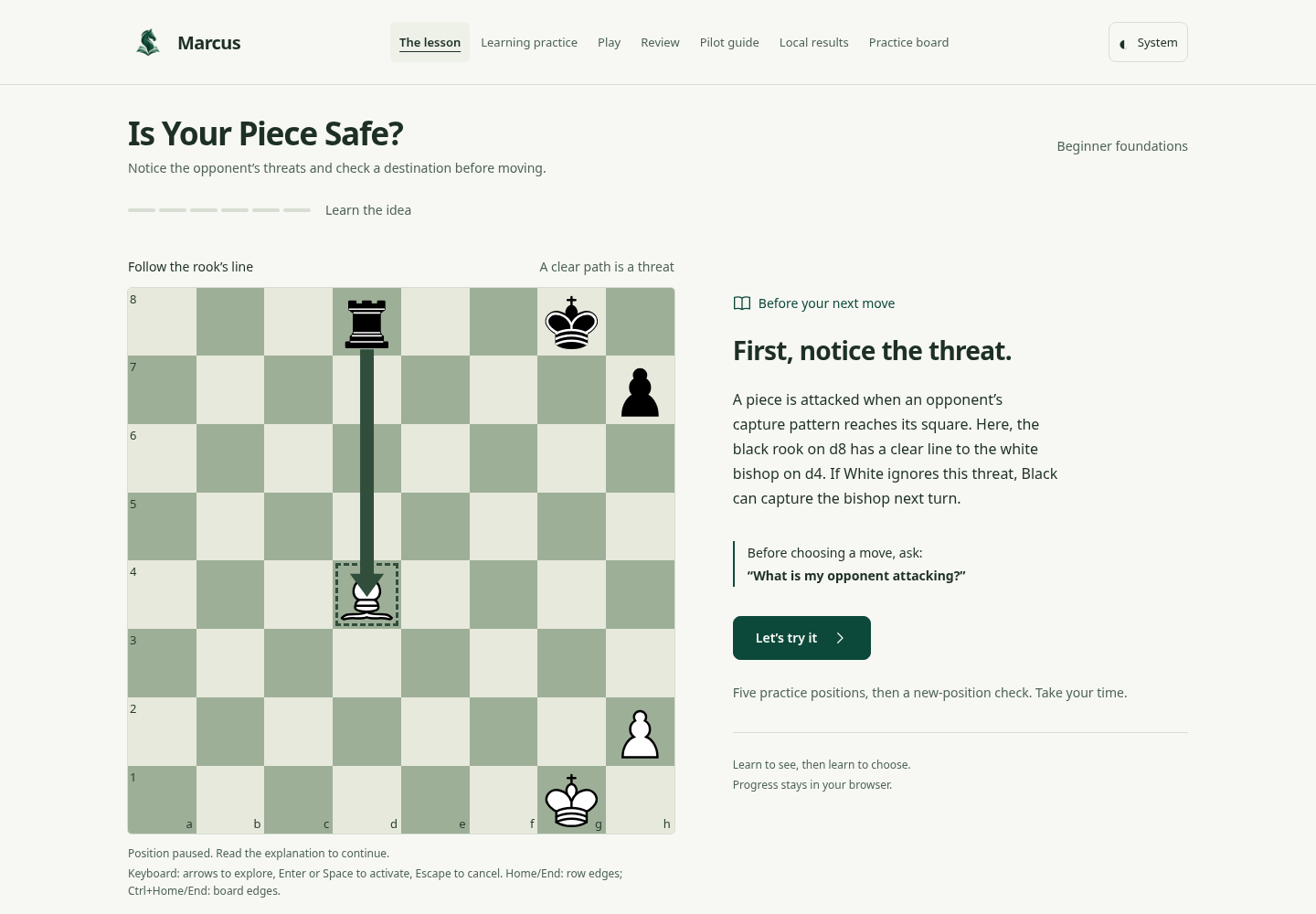
Choose a detail step to use zoom and dimming.
The public deployment now uses Marcus branding. This fresh capture shows its actual lesson; progress is confined to a new browser context.
Guided inspection
Step 1 of 5
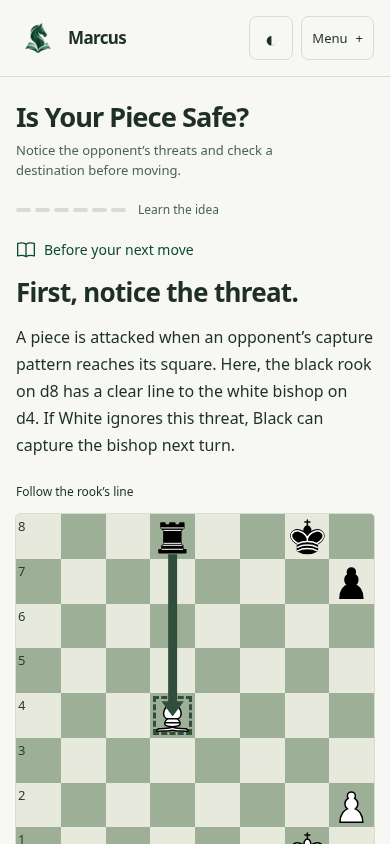
The guided lesson explains a rook threat visually, then asks the learner to practise and check a new position.
Authentic application captures. These controls explore screenshot evidence; they do not operate the app. Use Zoom to evidence, dim the surroundings, or open the full-resolution image. The text transcript below works without JavaScript.
The guided lesson explains a rook threat visually, then asks the learner to practise and check a new position.
The public deployment now uses Marcus branding. This fresh capture shows its actual lesson; progress is confined to a new browser context.
Inspect corresponding screenshot (opens in a new tab)Adaptive practice separates baseline, guided exercises, unfamiliar transfer checks and delayed review.
Hint-assisted retries and familiar boards are not treated as independent evidence of mastery.
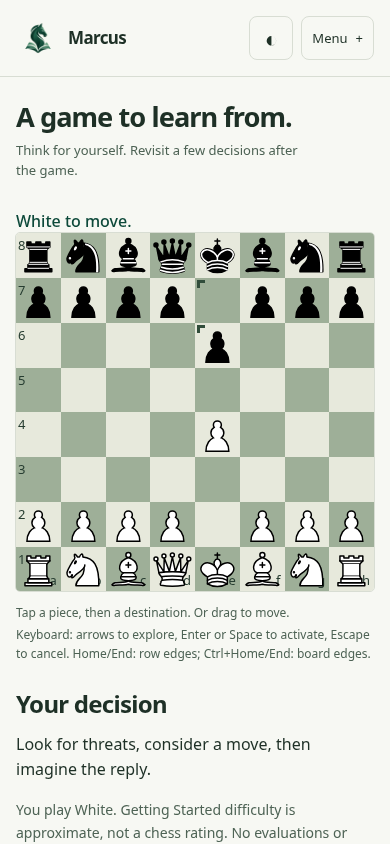
Inspect corresponding screenshot (opens in a new tab)A local WASM worker provides legal engine responses through the UCI adapter. Players can choose a side and a descriptive difficulty preset.
Presets bound engine resources and native skill. They are not calibrated human Elo levels.
Inspect corresponding screenshot (opens in a new tab)Coached review reconstructs a game, selects decisions and offers reflection, candidate moves and qualified tactical feedback.
This fresh capture reviews the actual browser-local demonstration game after a real Stockfish reply and resignation. Bounded proof does not establish strategic understanding or human coaching quality.
Inspect corresponding screenshot (opens in a new tab)The fresh Local results screen requires a completed baseline before showing results. Source-separated assessment export is supported by the earlier attributed verification.
This fresh session has no completed assessment; the screen truthfully asks the learner to finish the check. No evaluation totals, real pilot or learning-effectiveness result is invented.
Inspect corresponding screenshot (opens in a new tab)Read-only public deployment verified on 27 October 2026. Lesson and game progress stay in a fresh browser context; all non-read HTTP methods were blocked. No measured learning improvement is claimed.
Read the Phase 5D capture and verification report
Hints, familiar positions and gameplay review stay separate from unfamiliar checks. Earlier exposure is excluded conservatively; a simulated delayed test is not a retention study.
UCI lacks request IDs. Cancellation destroys the worker; generation checks reject late results. Bounded searches and explicit restart trade resources and speed against analysis depth.
Mechanical attack facts cannot evaluate every sacrifice. Bounded mate proofs support qualified feedback; deeper tactical and strategic value remains unassessed. Descriptive difficulty needs actual beginner calibration.
Exercise selection and evidence rules live outside React. Versioned progress validation prevents malformed data or repeat attempts from becoming unsupported mastery.
src/domain/adaptive/session.ts (opens in a new tab)A replaceable worker port bounds resources, validates legal principal variations and handles timeout, cancellation, disposal and restart.
src/engine/uci-engine.ts (opens in a new tab)Full-game replay and review decisions remain distinct from assessment. Familiar-position observations do not enter unfamiliar evaluation denominators.
src/domain/review/decisions.ts (opens in a new tab)Upstream results below are attributed to their recorded checks. This portfolio change does not rerun every application suite.
The upstream Phase 2B report records 177 passing unit tests across 13 files and one default engine skip. A separate actual pinned-engine integration passed four presets and three benchmark searches. These are prior upstream checks, not rerun by this portfolio change.
Phase 2B records 34 Chromium scenarios; the later Phase 2C report records 46 while preserving learning/engine logic. Lint, strict TypeScript and the isolated Webpack build passed in those recorded upstream checks. None establishes physical-device readiness or educational effectiveness.
The retained Phase 2C captures show the real lesson, learning-practice entry, playable game, reflection review and local evaluation. Synthetic assessment totals and the 14-position benchmark are test material. No real learner pilot, retention improvement or 10× effectiveness has been measured.
Working implementation and release readiness have different evidence requirements.
Links point to the current committed Marcus source. Phase 2B and 2C reports are historical technical verification, not learner studies. The latest source contains release preparation, while licensing/corresponding-source and educational-validation gates remain open.